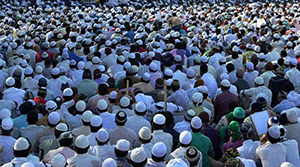
Bengali Muslims constitute the world’s second-largest Muslim ethnicity (after the Arab world) and the largest Muslim community in South Asia. The endogamous Bengali Muslim population emerged as a synthesis of Islamic and Bengali cultures.
The differentiation of identities within Bengali society is a relatively modern concept. To the modern mind, religion appears as a fixed identity where there are specific and well-defined beliefs and practices. Islam has been so finely woven in the Bengali
fabric that it is almost impossible to determine where one thread coming from local beliefs, and another from Islamic belief, begins and ends. This helped to create a unique Bengali Muslim identity different from other Islamic cultures, where Muslims and Hindus could venerate common deities and holy men (Pirs), and pay tributes to the same shrines (Mazars) (Anisuzzaman, M. (2002) ‘The Identity Question and Politics’ in Rounaq Jahan, (ed.) Bangladesh: Promise and Performance, Dhaka: University PressLimited).
The Partition of Bengal in 1905, and the formation of the Indian Muslim League in 1906 were the two significant events of a period that could be considered the key moment of increased political and religious consciousness among Bengali Muslims in British India
Nawab Salimullah emerged as a leader of the Muslim community, especially of East Bengal. He supported the Partition scheme (1905) and organised a movement in its favour. In a speech in Dhaka (in then East Bengal) on 18 February, 1904, Lord Curzon, the Viceroy of British India between 1898 and 1905, alluded to a Bengal Muslim identity, in saying ‘Partition (of Bengal) would make Dhaka the centre and possibly the capital of a new self sufficing administration which must give to the people of these districts by reason of their numerical strength and their superior culture the preponderating voice in the province so created, which would invest the Mohammedans in eastern Bengal with a unity which they have since the days of the old Musalmaan Vice-Roy and kings’.
A.K. Fazlul Haq called for more than one state for the Muslims of India, thereby securing Bengali Muslims rights and interests in Bengal (Ayoob, Mohammed (1975), p,2-3): India, Pakistan and Bangladesh, New Delhi: Indian Council of World Affairs).


 Bengal Muslim Identity
 Bengal Muslim Identity