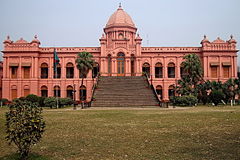
Ahsan Manzil is situated in the old city of Dhaka, Bangladesh.
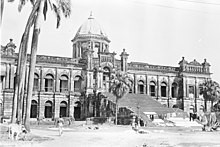
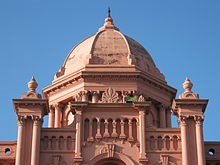
The building, one of the most significant architectural monuments of Bangladesh, is situated at Kumartoli along the banks of the Buriganga river in Dhaka. Construction was started in 1859 and was completed in 1872. It was constructed in the Indo-Saracenic Revival architecture. It has now been designated by the Bangladesh Government as a national museum.
In around 1740, the original owners sold the property to the wealthy French traders who used it principally as their trading house. Following the increasing dominance of the English under British rule, the French was forced to leave the Indian subcontinent. They decided to sell all their properties in Dhaka and in 1830, the trading house of Kumartuli was purchased by the then established landlord of Dhaka, Khwaja Alimullah.
After some renovation work, the trading house became the residential palace of Khwaja Alimulllah . In his time, a stable and a family mosque was added in the compound. After his death, his son Khwaja Abdul Ghani made a great flourish to the property, and named it “Ahsan Manzil” after his son Khwaja Ahsanullah. In the east side of the old building, he made a new building with a different design, and also a great of renovation work was done to the old building. Since then, the old building was called “Ondor Mohol” and the new building was called “Rong mohol”.
Ahsan Manzil is a witness to many historical events. From the last part of the 19th century to the initial years of Pakistan, the Muslim leadership of East Bengal emerged from this palace. The successive Nawabs of Dhaka used to conduct their daily court affairs here as chief of the panchayet (village council). Many anti-India Congress meetings were held in Ahsan Manzil under the patronage of Nawab Ahsanullah, a staunch believer in Muslim identity. Almost all the Viceroys, Governors and Lieutenant Governors of British India who visited Dhaka spent some time at the Ahsan Manzil. Most political activities of Nawab Khwaja Salimullah centred round this palace. With the decline of the Nawab family of Dhaka, the importance of Ahsan Manzil also began to decline.
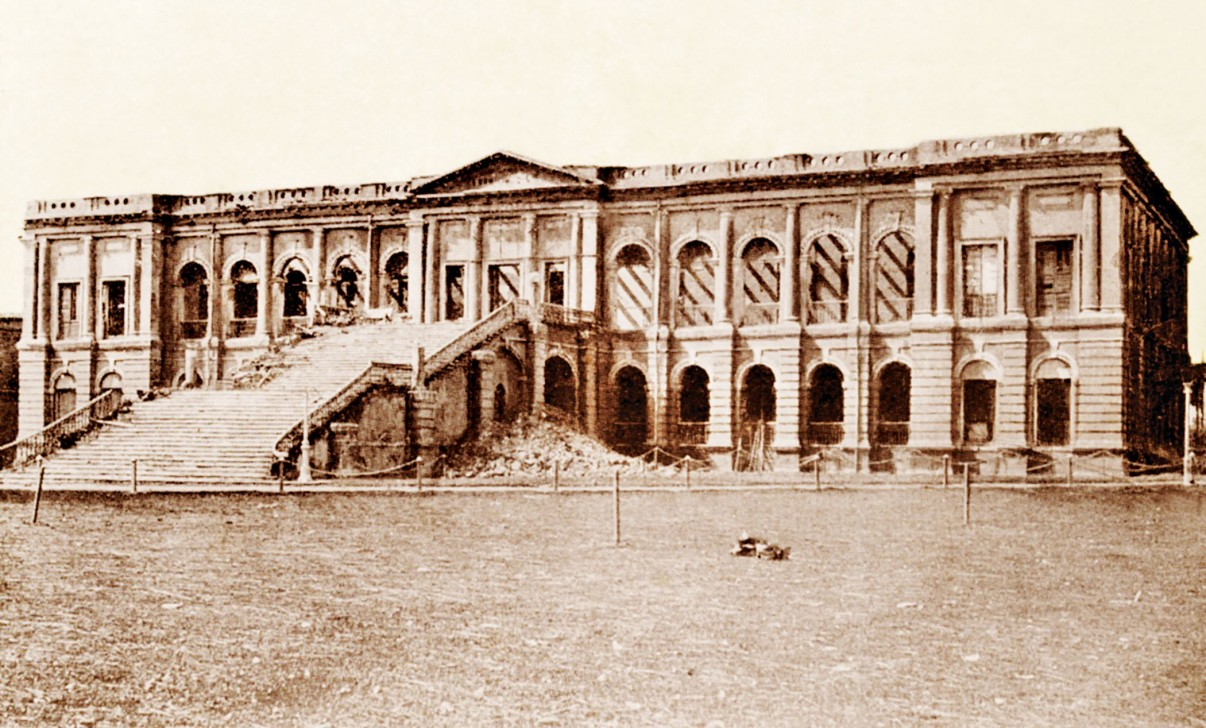
The Ahsan Manzil in the aftermath of the devastating tornedo, Dhaka, 1888. Writer’s collection. Photo: Johnston & Hoffmann, Calcutta


 AHSAN MANZIL
 AHSAN MANZIL
 In around 1740, the original owners sold the property to the wealthy French traders who used it principally as their trading house. Following the increasing dominance of the English under British rule, the French was forced to leave the Indian subcontinent. They decided to sell all their properties in Dhaka and in 1830, the trading house of Kumartuli was purchased by the then established landlord of Dhaka, Khwaja Alimullah.
 After some renovation work, the trading house became the residential palace of Khwaja Alimulllah . In his time, a stable and a family mosque was added in the compound. After his death, his son Khwaja Abdul Ghani made a great flourish to the property, and named it “Ahsan Manzil” after his son Khwaja Ahsanullah. In the east side of the old building, he made a new building with a different design, and also a great of renovation work was done to the old building. Since then, the old building was called “Ondor Mohol” and the new building was called “Rong mohol”.