A.K. Fazlul Huq proved a rare figure in the Independence and partition era of the history of the India Sub Continent. He became the first Muslim Mayor of Kolkata. As a scholar, he sought to build bridges between Muslim and Hindu, writing Understanding the Muslim Mind. He is remembered as a fierce advocate of the independence of Pakistan and Bangladesh, the “Bengal Tiger” nickname stuck. Huq sought to unite Muslims and Hindus communities under a shared banner.
A.K. Fazlul never led the movement for two separate nations out of a sense of hatred for Hindus. He sought to thwart the Muslim drive for a separate nation. With Independence from British rule, the Muslim support of an independent Pakistan, and Hindu support for a Hindu India, prove a tide impossible to stop. Later, Huq supported the creation of Bangladesh, rejecting West Pakistan’s attempt to seek dominance over East Pakistan. Huq provided leadership for the emerging nation of Bangladesh, placing his stamp of care for the poor on his leadership.
Born in his mother’s town of Saturia in Jhalokati district (present day Bangladesh), Huq’s primary education began at a local Pathshala (informal village school). He obtained a BA degree (with triple Honors in Chemistry, Mathematics, and Physics) from Presidency College, Kolkata and an MA in Mathematics from Calcutta University. He completed his formal education with a Law degree in 1897, from the University Law College, the second Muslim in the Indian subcontinent to do so,
Sir Khwaja Salimullah and Syed Nawab Ali Chowdhury initiated Fazlul Huq into politics. With their assistance, he entered the Bengal Legislative Council in 1913, as an elected member from the Dhaka (Dacca) Division. For 1913-1916, he served as the Secretary of the Bengal Provincial Muslim League and Joint Secretary of the All India Muslim League. Then, he served as the President of the All India Muslim League from 1916 to 1921. He played an instrumental role in formulating the Lucknow Pact of 1916, between the Congress and the Muslim League. In 1917, he became Joint Secretary of the Indian National Congress, serving as General Secretary 1918-1919.
In 1919, Fazlul Huq joined the Khilafat movement. But he had a difference of opinion about non-cooperation with mainstream Congress leaders. Though he supported the boycott of British goods and titles, he opposed the idea of boycotting of educational institutions, particularly considering the backward condition of the Muslim community. That difference of opinion eventually led to his departure from Congress.
The Muslims nominated the mayor in Calcutta in 1935. With the Congress’ support, they elected Fazlul Huq the first Muslim mayor of Calcutta. Prior to 1937 election, Fazlul Huq reorganized the defunct Proja-Shamiti and renamed it as Krishak Praja Party (KPP).
Sher-e-Bangla A. K. Fazlul Huq played the key role in the emergence of Bengali (especially Muslim) middle class in British India. After the partition of India in August 1947, Huq settled in Dhaka and served as the Advocate General of East Pakistan from 1947 to 1952. He soon got involved in Bengali Language Movement.
Rejection of West Pakistan’s dominance over East Pakistan, and the desire for Bengali provincial autonomy, comprised the main ingredients of the coalition’s twenty-one-point platform in the provincial election. After the elections A.K. Fazlul Huq became the Chief (or Prime) Minister, of East Bengal (East Pakistan).
The East Pakistani election and the coalition’s victory proved pyrrhic; Bengali factionalism surfaced soon after the election and the United Front fell apart. From 1954 to Ayub’s assumption of power in 1958, the Sramik-Krishak Dal led by A.K. Fazlul Huq and the Awami League led by Suhrawardy engaged in a ceaseless battle for control of East Pakistan’s provincial government. In August 1955, he accepted the invitation to join the central cabinet as Pakistan’s Home Minister. In 1956, he became the Governor of East Pakistan, leaving that post in 1958.
Source: https://www.newworldencyclopedia.org/entry/A.K._Fazlul_Huq
Further reading:
https://www.thedailystar.net/in-focus/sher-e-bangla-ak-fazlul-huq-1219987
http://en.banglapedia.org/index.php?title=Huq,_AK_Fazlul


 Fazlul Haq
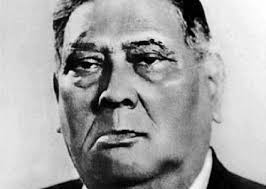 Fazlul Haq