Goaldi Mosque is situated in Sonargaon, close to Dhaka, Bangladesh.
Sonargaon (literal meaning Golden Village), was the historic capital city of the independent Sultanate of Bengal and survives at present in the name of an upazila (sub-district) in the Narayanganj district. Sonargaon was brought under Muslim rule in the 13th century, first by the Delhi Sultanate then by the independent sultans of Bengal, after which it was taken by the Mughals in 1608.
According to an inscription, the Goaldi Mosque was built by a Mulla Hizabar Akbar Khan on 15 Shaban in 925 AH/ August 1519 AD, during the reign of Sultan Alauddin Husain Shah who founded the Hussain Shah dynasty that ruled Bengal from 1494 to 1538.
This is a pre-Mughal mosque and more elegant and ornate in comparison to the earlier Sultanate mosques at Bagerhat. The mosque has three richly carved mihrabs. Of the three mihrabs, the central is beautifully embellished with carved floral and arabesque relief on black stone/basalt which is decorated with beautiful, intricate patterns composed of an ornamental hanging lamp motif, while the other mihrabs are decorated with bricks and fine terracotta work instead of black stone/basalt. Each wall has three arched entrances, the central arch slightly higher than the others. A single graceful hemispherical dome rises above the slightly curved cornice. Miniature arches with terracotta designs are placed below the cornice and above the entrance arches. Round corner turrets that rise up to the cornice and have two moldings at the centre and triple moldings at the base, just above which are more terracotta arches.


 GOALDI MOSQUE
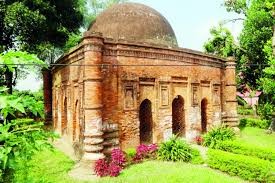 GOALDI MOSQUE
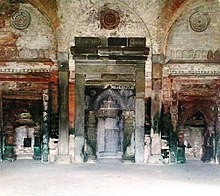 This is a pre-Mughal mosque and more elegant and ornate in comparison to the earlier Sultanate mosques at Bagerhat. The mosque has three richly carved mihrabs. Of the three mihrabs, the central is beautifully embellished with carved floral and arabesque relief on black stone/basalt which is decorated with beautiful, intricate patterns composed of an ornamental hanging lamp motif, while the other mihrabs are decorated with bricks and fine terracotta work instead of black stone/basalt. Each wall has three arched entrances, the central arch slightly higher than the others. A single graceful hemispherical dome rises above the slightly curved cornice. Miniature arches with terracotta designs are placed below the cornice and above the entrance arches. Round corner turrets that rise up to the cornice and have two moldings at the centre and triple moldings at the base, just above which are more terracotta arches.