Hussaini Dalan is an Imambara situated in Dhaka, Bangladesh.
It is the main Imambara for the Shia community originally built by a person named Mir Murad during the later half of the Mughal rule in the 17th century under the Governorship of Prince Shah Shuja, son of Mughal Emperor Shah Jahan and Empress Mumtaz Mahal.
Although Shuja was a Sunni Muslim, he patronised Shia institutions as well. According to tradition, “Mir Murad had a vision of Imam Hussain erecting a ‘taziah khana’ or house of mourning which led to the construction of Hussaini Dalan.
The original date of construction is still disputed, but Hussaini Dalan in its present form is attributed to Nawab Nazim Nusrat Jung, who was the longest serving Naib Nazim (Mughal political officer) in Dhaka, holding the post for over three decades, from 1785 to 1822 and he rebuilt the Imambara in 1823. During the time of the British East India Comany it was repaired in 1807 and 1810. The present flat roof was rebuilt by Nawab of Dhaka Sir Khwaja Ahsanuallah Bahadur after the earthquake of 1897.
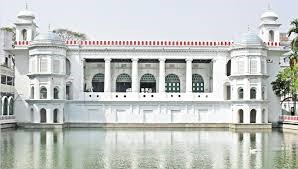
The building stands on a high platform ascended by a flight of steps on the east and consists of two main halls placed back to back. The shirni hall, facing south, is coloured black to indicate sorrow and mourning for the death of al-Husain, and the khutba hall, facing north, has a mimbar with seven wooden steps. In the latter hall are hung several religious symbols. To these halls have been added subsidiary halls in two storeys on the right and left, probably meant for women. The southern facade of the building is flanked by two three-storey polygonal hollow towers, crowned by domes.
The parapet of the building consists of coloured merlons, and over its four corners are four kiosks. The building as a whole gives a modern appearance with remnants of older architecture here and there. The exterior incorporates both Mughal and British architectural traditions.


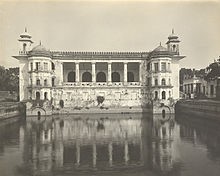 The original date of construction is still disputed, but Hussaini Dalan in its present form is attributed to Nawab Nazim Nusrat Jung, who was the longest serving Naib Nazim (Mughal political officer) in Dhaka, holding the post for over three decades, from 1785 to 1822 and he rebuilt the Imambara in 1823. During the time of the British East India Comany it was repaired in 1807 and 1810. The present flat roof was rebuilt by Nawab of Dhaka Sir Khwaja Ahsanuallah Bahadur after the earthquake of 1897.
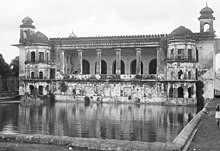 The building stands on a high platform ascended by a flight of steps on the east and consists of two main halls placed back to back. The shirni hall, facing south, is coloured black to indicate sorrow and mourning for the death of al-Husain, and the khutba hall, facing north, has a mimbar with seven wooden steps. In the latter hall are hung several religious symbols. To these halls have been added subsidiary halls in two storeys on the right and left, probably meant for women. The southern facade of the building is flanked by two three-storey polygonal hollow towers, crowned by domes.